
Careers Education, Information and Guidance
Careers Overview
At Marshland High School it is our vision to empower every student to discover their strength and ambition with a programme that helps them explore a wide range of career pathways and real-world opportunities. We aim for all students to make confident, informed choices about their futures.
The core programmes of study are delivered through Character and Culture in Years 7-9, during Tutor Time for Year 7-11 and on Super Learning Days. Students also learn about careers throughout the curriculum.
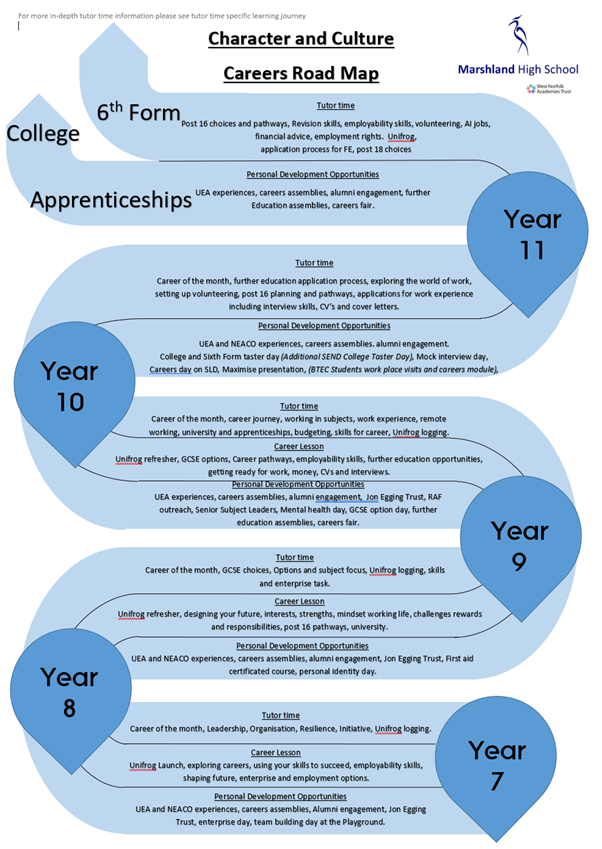
All Year 10/11 students will be given the opportunity to attend a careers interview with a Level 6 Qualified Careers Advisor to discuss aspirations and next steps. Should an additional appointment be required to support Year 9 options or post-16 choices, please speak to Mr Teanby, Mrs Whitehouse or your Pastoral Lead who will be able to organise this for you. All advice given will be impartial, ensuring that all post 16 pathways are explained and available to all students. There will be no bias attributed to academic, vocational, or work opportunities as part of the curriculum or careers guidance.
All Year 10 students have the opportunity to go on a week’s work experience. This will take place in the Summer term. Details will be sent to parents in December.
CIEAG Policy
Our aim as a school is to provide an inclusive, effective and stable careers strategy that raises our students’ aspirations throughout the entirety of their school career.
To view our Careers Education, Information, Advice and Guidance Policy click here.
CEIAG makes a valuable contribution in the preparation of students for the opportunities, responsibilities and experiences of life by enabling them to make informed choices for post 16 education and training facilitating a successful transition from mainstream education to further education and employment. At Marshland High School we work hard to provide the opportunity for students to speak to a careers advisor for up to date advice, provide opportunities to hear from Post-16, further education providers and other training providers to ensure they make the right choice for them. We have successfully completed the Quality in Careers Standard. Our certificate can be viewed here.
Meet the Careers Team:

Mrs. C Whitehouse
As Career's Lead, I am passionate about helping students explore their aspirations and make informed decisions about their future pathways. I work closely with students, staff, employers and education providers to deliver a comprehensive careers programme that inspires ambition, develops employability skills and supports every young person in achieving their goals.

Mrs. C Walton

Mr. D Stannard

Miss. N Ward
Tel: 01945 584146
Email: mhs-careers-leader@marshlandhigh.co.uk
Careers in the Curriculum
At Marshland High School, all staff are committed to bringing their subject to life for our students. This enables them to develop a greater understanding of how the skills and knowledge they develop in lessons can lead to different career pathways. Some of the ways we do this are by:
- Promoting employability skills during lessons such as oracy, teamwork, communication and leadership
- Discussing careers in lessons so that students understand how their subjects lead to different careers
- Creating displays within each Department to promote career pathways and raise aspirations
- Inviting speakers into school to deliver assemblies, talks or run workshops.
- Invite employers into school to run experience of work days.
To explore different careers related to your favourite subjects click on the carousel of posters below:


Employability
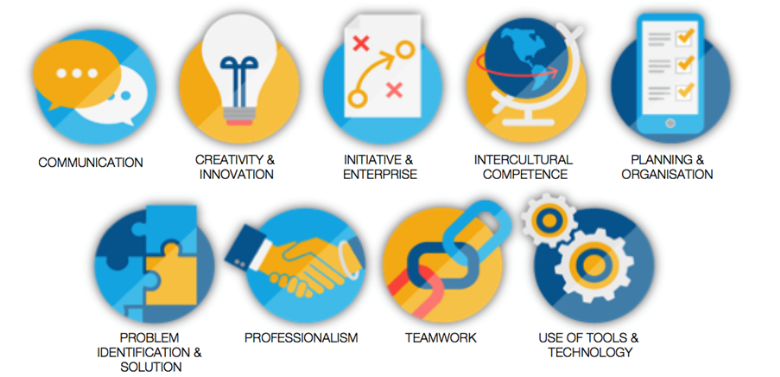
When students start applying for jobs or for college, they will need to talk about the skills and experience they have. Many skills are useful in almost every career. These are often called employability skills, enterprise skills, soft skills, or transferable skills.
These skills can be used in many different jobs and situations. Examples include communication, teamwork, problem-solving, and leadership.
Watch the video that explains employability skills:
At Marshland High School our Careers curriculum covers the key employability skills:
Students and parents can access www.unifrog.com that can support you in understanding and developing employability skills.
Labour Market
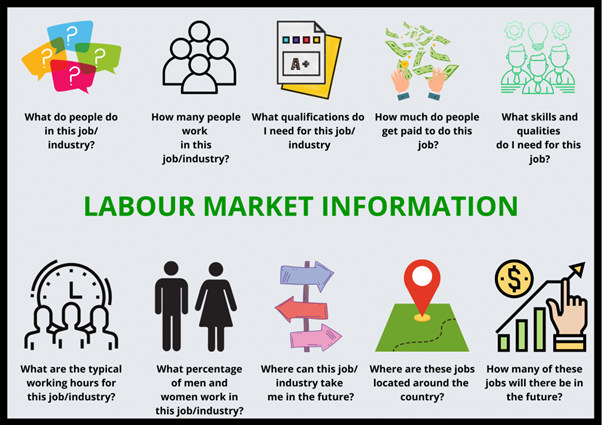
Labour Market Information
Understanding local and national labour market information is becoming more important because the world of work is changing quickly. This is happening because of globalisation and new technology. Students need to know what skills and knowledge employers are looking for.
Read on to find out more about what labour market information means:
To find out more about what is happening in the labour market in the East of England or Nationally, click on the posters below:
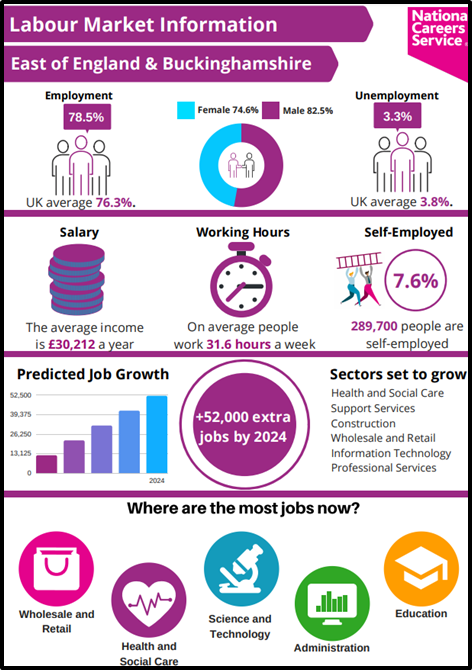
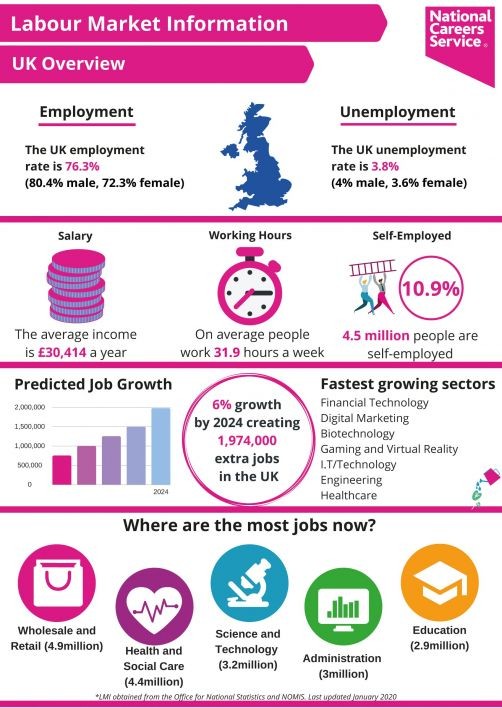
Click Here for link to National Careers Service
Click Here for Cambridgeshire and Peterborough Labour Market Information
Post 16 Options
It is never too early to start thinking about your future. What you can do after GCSE depends on a range of factors such as where you live and where you are able to travel to, what grades you are likely to get, what you are interested in, and what environment you are most suited to.
Since 2013, the Raising of the Participation Age law has stated that young people must undertake formal education until they are 18. This can include:
Full-time Study – this could be a qualification taken at a Sixth Form, College or a Independent Training Provider, totalling 540 hours of learning time per year, or around 18 hours per week. This can be either an academic or vocational route.
Apprenticeships – this involves working for an employer while studying for a qualification as part of your training. Usually, work makes up 80% of an apprenticeship and at least 20% should be dedication to studying.
T-Levels – this involves 80% of the time studying a technical course at College and 20% gaining work experience within a related field with an employer.
Traineeships – this is an option for students who would like to do an apprenticeship but may not have the experience, skills or qualifications to do so yet. Traineeships can last up to six months and involve a work placement, Maths and English qualifications and support with finding an apprenticeship.
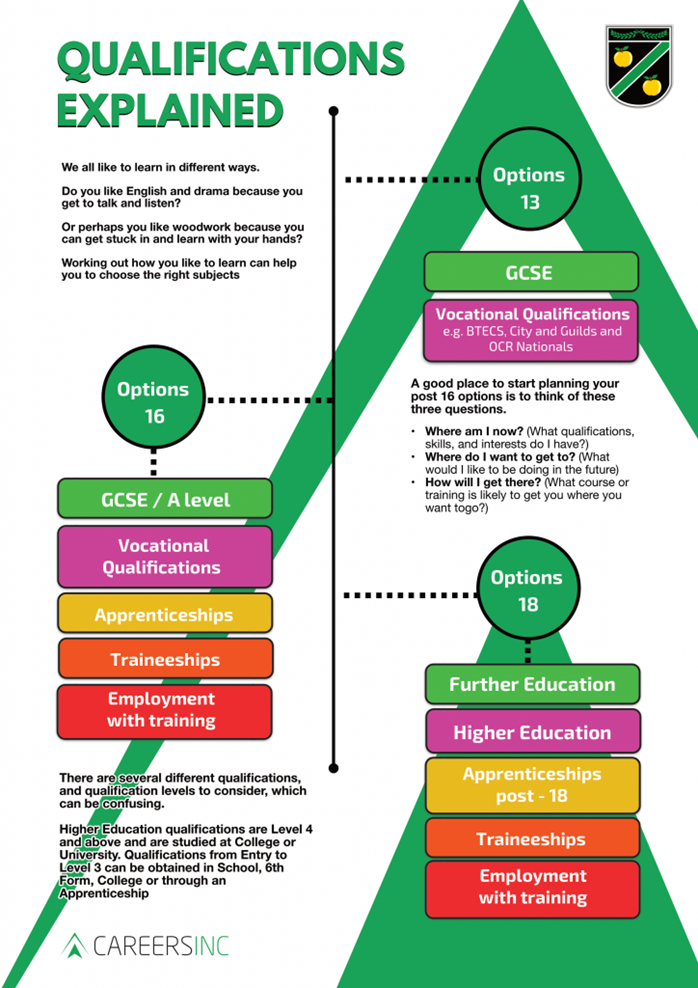
A good place to start planning your post-16 options is to think of these three questions.
- Where am I now? (What qualifications, skills, and interests do I have?)
- Where do I want to get to? (What would I like to be doing in 5 years’ time – job, living away from home, etc?)
- How will I get there? (What course, training or future job is likely to get me where I want to go?)
Of course, at 16, young people don’t necessarily know the answers to all these questions, but it is never too early to start exploring information about careers, jobs and courses.
If you really aren’t sure about what you want to do in the future then ‘stay broad’ – do a broad range of subjects so that you can decide later!
It might also help to get advice from people who know you well (like parents & teachers) or request to speak to the school Careers Advisor or Careers Leader.
Where to study?
Sixth Form and Sixth Form Colleges
Sixth Forms are often attached to a school and sometimes sixth forms are completely separate from any other schools, and teach students from lots of different places. The courses available are main A Level but some do include vocational qualifications like BTEC too. A Levels offer a great route into Higher Education and Employment.
Further Education Colleges
Further Education Colleges offer a range of courses that can help at every stage of life from Level 1 courses through to degrees and professional qualifications. Colleges offer a range of full-time and part-time courses related to a broad employment area such as Business, Engineering, IT, Health and Social Care that can lead to a specific job or related further study at Higher Education and some also offer a range of A Levels too.
Training Providers
Training Providers usually offer BTECs or other vocational qualifications that focus on a specific area of study in a practical way such as Hair and Beauty, Construction, Animal Care, Performing Arts, Business/ICT or Engineering.
Apprenticeships and Traineeships
Apprenticeships
Apprenticeships involve working for an employer in a specific role while being trained to do the job by experienced staff, in a combination of on the job and off the job training at a college or training provider (this must be at least 20% of the apprenticeship).
Apprenticeships can now be undertaken in a variety of industries and can be started as soon as an individual turns 16 and has left full time education (although you can apply beforehand).
Apprenticeships come in four different levels:
Intermediate/Level 2 (equivalent to GCSE) – may require Maths/English at GCSE
Advanced/Level 3 (equivalent to A Level) – usually requires 5 GCSEs at Grade 4 and above
Higher/Level 4-5 (equivalent to Foundation Degree) – usually requires L3 or A Levels
Degree/Level 6-7 (equivalent to University Degree) – usually requires 3 A Levels or similar
Apprenticeships are applied for directly through the company. They can be found through: https://www.gov.uk/apply-apprenticeship
youtube.com/watch?v=Ae5cpIdJ8RU&embeds_referring_euri=https%3A%2F%2Fwww.theappletonschool.org%2F (embed video)
Qualifications
Depending on the Sixth Form/College/Training Provider you choose to study at you may have the choice to study A Levels on their own or alongside an Applied General Qualification. Some Further Education Colleges will also offer T Levels from September 2021.
A Levels are Academic, T Levels are Technical and Applied General Qualifications are courses that focus on a vocational area and are more practical.
A Levels
- Students usually take 3 or 4 different A Level subjects or you can do 2 alongside an Applied General Qualification
- Each A Level is graded A*-E and attract UCAS points for entry to university (ucas.com)
- A Levels are general and academic and are a good choice if you want to keep your career options open
- You can choose a subject you enjoyed at GCSE or pick up a new subject such as Law, Economics or Psychology
- Some degrees and universities will only accept specific subjects and grades for entry to certain degree courses at university so it is important to do your research
- A Levels do not suit everyone. They are usually assessed at the end of two years by final exams, so you need to be good at independent study, revision and exam technique
T Levels
- T Levels are a relatively new qualification that follow GCSEs and give students a head start towards a specific career
- T Levels are technical qualifications where you study one subject which is equivalent to 3 A Levels, the top grade is Distinction which is equivalent to 3 A Levels at A
- They combine classroom study and work placements (80% classroom and 20% work placement)
- T Levels begin with core theory, concepts and skills relating to an industry area and students will then be able to choose one or more specialism
Applied General Qualifications
- These are vocational qualifications that tend to be known by the exam board such as BTEC, Cambridge Technicals, OCR
- There are a wide range of Applied General Qualifications available from animal care to performing arts and business to graphic design at different levels
- They offer the underpinning knowledge of a subject, practical skills and relevant work experience. So they will suit students who have an interest in a specific job area eg Health and Social Care
- These can be taken alongside two A Levels or as one course equivalent to two or three A Levels
- Generally, there are less exams and a range of different assessment methods are likely to be used such as assignments, tests and observations of performance
- Students can progress on to university to study a degree or go on to an apprenticeship after these qualifications
For more information click on the image or link below and for a summary of the qualification’s pathways watch the short animation produced by the Department for Education: https://nationalcareers.service.gov.uk/careers-advice/career-choices-at-16
Careers Curriculum
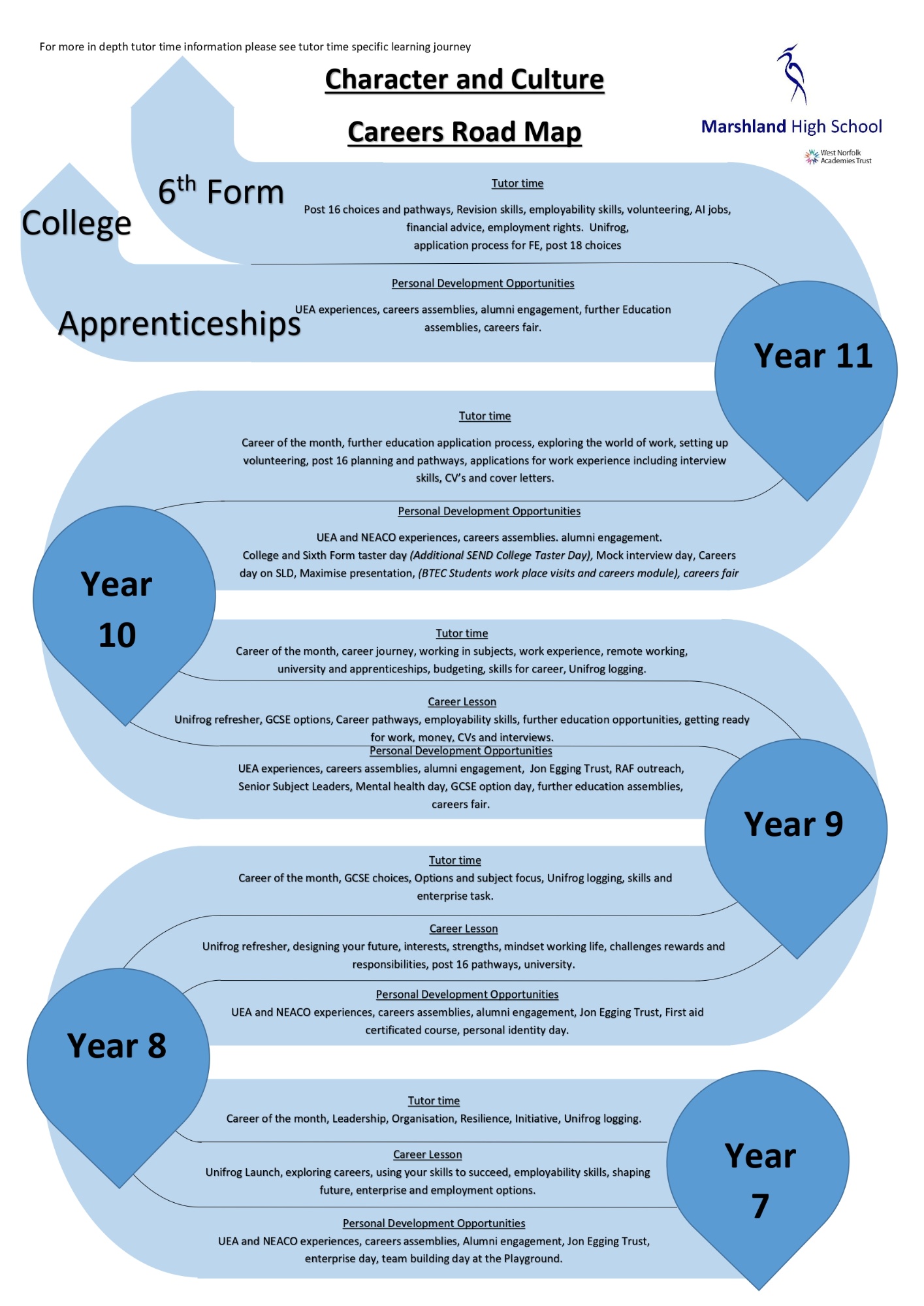
Please see our Careers Year plans for each individual year group below:
KS3
| KS3 Careers Year Plan | Year 7 Tutor Time Year Plan |
| Year 8 Tutor Time Year Plan | |
| Year 9 Tutor Time Year Plan |
KS4
| Year 10 Tutor Time Year Plan | |
| Year 11 Tutor Time Year Plan |
The impact of our careers programme is monitored regularly through pupil voice activities; pupil, staff, and supporting employers, questionnaires; learning walks; book scrutinies where appropriate.
Provider Access
Access
The school complies with the new legal requirement of a minimum of 4 encounters with providers of approved technical education qualifications and apprenticeships. Students receive at least one assembly in KS3 and one in KS4 with the Springwood High School, College of West Anglia and Norfolk Pathways. Norfolk Pathways and other apprenticeship providers from industry support the school in workshops and careers fair and mock interview days, providing information to students and parents.
How to gain access
Providers can request access by emailing MHS-Careers-leader@marshlandhigh.co.uk. Requests will not be considered if approached through other means. The email should include what information they would like to be disseminated to the students or parents and include the resources to support this. Access to students will be granted through written communication, brochures and adverts for events and will be shared with students through their careers MyChildatSchool App. Information may be shared by email with students or parents if deemed a more effective way of providing information. Access may be granted for workshops or assemblies when this matches the intended curriculum.
Work Experience
Key Stage 3 World of Work
At Key Stage 3, all students take part in a range of exciting and engaging careers activities designed to broaden their understanding of the world of work and inspire future aspirations.
In Year 7, students participate in an Enterprise Day, where they meet a local entrepreneur, work collaboratively to design and create a product, and present their ideas in a Dragons' Den-style challenge. This experience develops creativity, teamwork, problem-solving and presentation skills while introducing students to the fundamentals of entrepreneurship.
In Year 8, students explore careers within the growing sustainable energy sector by taking on a variety of workplace roles. They work together to design, manufacture and test innovative products, gaining first-hand experience of how different skills and professions contribute to a successful project.
Throughout Key Stage 3, students also benefit from additional careers and employer engagement activities delivered in partnership with the Armed Forces and the Ambulance Service. These experiences provide valuable insight into a wide range of career pathways, helping students develop employability skills, challenge stereotypes and begin to make informed decisions about their future.
Year 10 Work Experience
All Year 10 students have the opportunity to take part in a one-week work experience placement with a local employer. Placements are available across a wide range of industry sectors, giving students the chance to experience the workplace, develop essential employability skills, and gain a valuable insight into different career pathways.
Work experience helps students build confidence, improve their communication and teamwork skills, and make informed decisions about their future education and career aspirations. It also provides an excellent opportunity to apply the skills they have developed in school in a real working environment.
We are grateful to the many local employers and organisations that continue to support our work experience programme by providing high-quality placements for our students.
Our work experience week for 2026/2027 is 12th July - 16th July. To view a list of the companies and organisations that have supported our work experience programme, please click here.
Next review of published information- September 2026